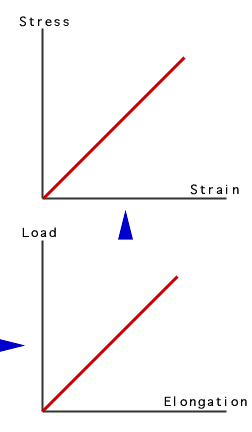
| This is done to assure that the specimen will fail in a specific region. The specimen is evaluated within this region by marking a gage length and observing how much change occurs during the loading. The gage length is usually 2 inches, and the diameter (for round specimens) is .505 inches. The dimensions are for convenience. A diameter of .505 has a cross sectional area of .2 square inches. Because the area is reduced in this section of the specimen, the stress will be greater (remember S=P/A). So we now have a convenient way of observing changes in length by comparing how much the material stretches when a load is applied. This change can be plotted on a stress-strain diagram or a load-elongation diagram as shown below. | ||
| Strain
can be calculated using the following formula:
e = (lf - lo ) / (lo) Example: A standard specimen is loaded to 2000 lbs and the gage length measures 2.003, what is the strain at this load? Solution: e = (2.003 in. - 2.000 in.) / (2.000 in) = .0015 in./in. |
||