|
Thus we can say that mechanical properties indicate the strength
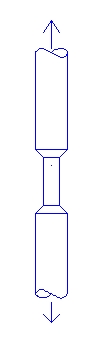
and deformability (change in shape) of a material. How a material deforms is useful in determining if it is suitable for products and processing. For example if the material deforms easily it may not have high enough strength but may process quite easily. So it is important to find the proper characteristics of a material to determine if it meets the requirements for both the product and the processing. Mechanical properties are usually determined by carrying out tests based on standards that define the procedure so comparisons can be made to the way a certain material is expected to behave. In this module we will look at material loading in several ways including tension, compression, shear and torsion. We will begin by looking at tensile strength. Tensile strength refers to a materials ability to resist being pulled apart . The diagram shown below shows a front view of a circular member loaded in tension. |
||
| Tensile
stress (S) is calculated by dividing the load (P) by the cross sectional
area (A).
S = P / A Example: A 1/2 inch diameter
steel rod is used to suspend a 5000 pound load. What is the tensile
stress in the rod ?
S = 5000 lbs. / .1964 sq. in = 25, 458.25 psi |
||
| Note: As the area increases the stress will decrease if the load remains constant. Similarly, knowing the required load to be carried by a member, enables the designer to determine the appropriate size based on the the mechanical properties of the material such as yield strength. This property will be discussed more in detail in the next section. | ||
| As the load is applied, the material will change in length. This is called strain, and is measured by comparing the change in length to the original length. This change can be expressed as either a percentage or a ratio with implied units being inches/ inch or mm/mm. When materials are tested, a standard must be followed. ASTM specifies test procedures and specimen size when conducting a tensile test. In order to more accurately observe the change in length a specific section of the test specimen is considered. Typically, a test coupon (specimen) will be reduced in size in the middle. | ||