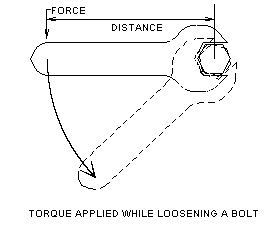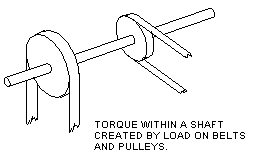
Torsion:   Torsion is simply created by twisting forces.  These forces have a moment (the product of force and distance).  Usually torque is applied to a solid shaft, and the shaft is used to transmit torque from the power source to the driven machine.  The machine needs a moment to turn a pulley, gear, or flywheel.   Torque may also be applied by using a crank or lever (such as an extension ratchet driving a socket.   When torque is applied to a material, it resists being twisted, thus stresses are created.  In torsion, these stresses are actually shear stresses.  Imagine a round piece of taffy with a red line painted the length of the piece of candy.  If it is twisted a "barber's pole" will result.  Actually, inside the round member there are shear forces present.  Think about the round bar being a column of washers.  If the torque is applied to one washer, it would slide or turn with respect to the adjacent washer and create a shear force.   The strength of a material in torsion is similar to tension in concept, however rather than using  force divided by area to find stress,  stress is the moment / the polar section modulus of elasticity.
EXAMPLES OF APPLIED TORQUE

EXAMPLE PROBLEM:  If 50 lb. force is applied to the handle of a 12 inch open-end wrench, how much stress is created in a 1/2 inch bolt?
Solution:  S = T / ZP;
   T = Force x Distance = 50 lb. x 12 in. = 600 lb-in.
   ZP (for solid shafts) = pi x D3 / 16; = (3.1416 x .53)/16
   S = 600 lb-in / .0245 in3 = 24,490 psi

BACK                  HOME              NEXT