Compression. The compressive strength of a material determines how much it deforms under a compressive load. Some materials such as concrete are strong in compression but weak in tension. Generally a material will respond in one of the three following ways:
For materials that are brittle only slight deformation occurs prior to fracture. However, with more ductile materials, failure may occur by either barreling (when the length is less than twice the diameter) or buckling (when the length is greater 2.5 times the diameter).
Compressive stress can be determined by the load divided by the cross sectional area.
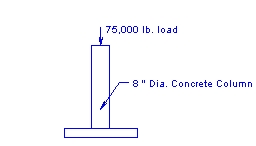
EXAMPLE PROBLEM: An 8 inch diameter concrete column is under a 75,000 pound static load. How much stress is the column subjected to?